



- This topic is empty.
-
AuthorPosts
-
27/11/2026 at 17:36 #13647
Buyers searching for reliable suppliers of PCM cooling garments in China who can provide custom phase point and pocket layouts are usually solving a specific operational problem: how to keep workers cool on sites where powered cooling equipment is restricted or impractical. This article examines that sourcing question in detail, using documented capabilities from Southern Sparkle Wearable Technology Co., Ltd., operating under the brand ELEHEAT, as a reference case for what a capable passive cooling garment supplier looks like.
Why Powered Cooling Falls Short on Many Industrial Sites
Industrial sites with powered equipment restrictions need body cooling that does not depend on batteries, pumps, or wiring. Crews working in battery-restricted areas, commercial kitchens, rescue operations, and hotspot assignments cannot rely on powered cooling devices, either because of safety rules, environmental exposure, or the simple logistics of charging equipment across many workers. This gap in the market is the starting point for evaluating any PCM (phase-change material) cooling garment supplier: the product has to work without electrical dependency while still delivering consistent thermal relief during a shift.
What a Passive Phase-Change Cooling System Actually Delivers
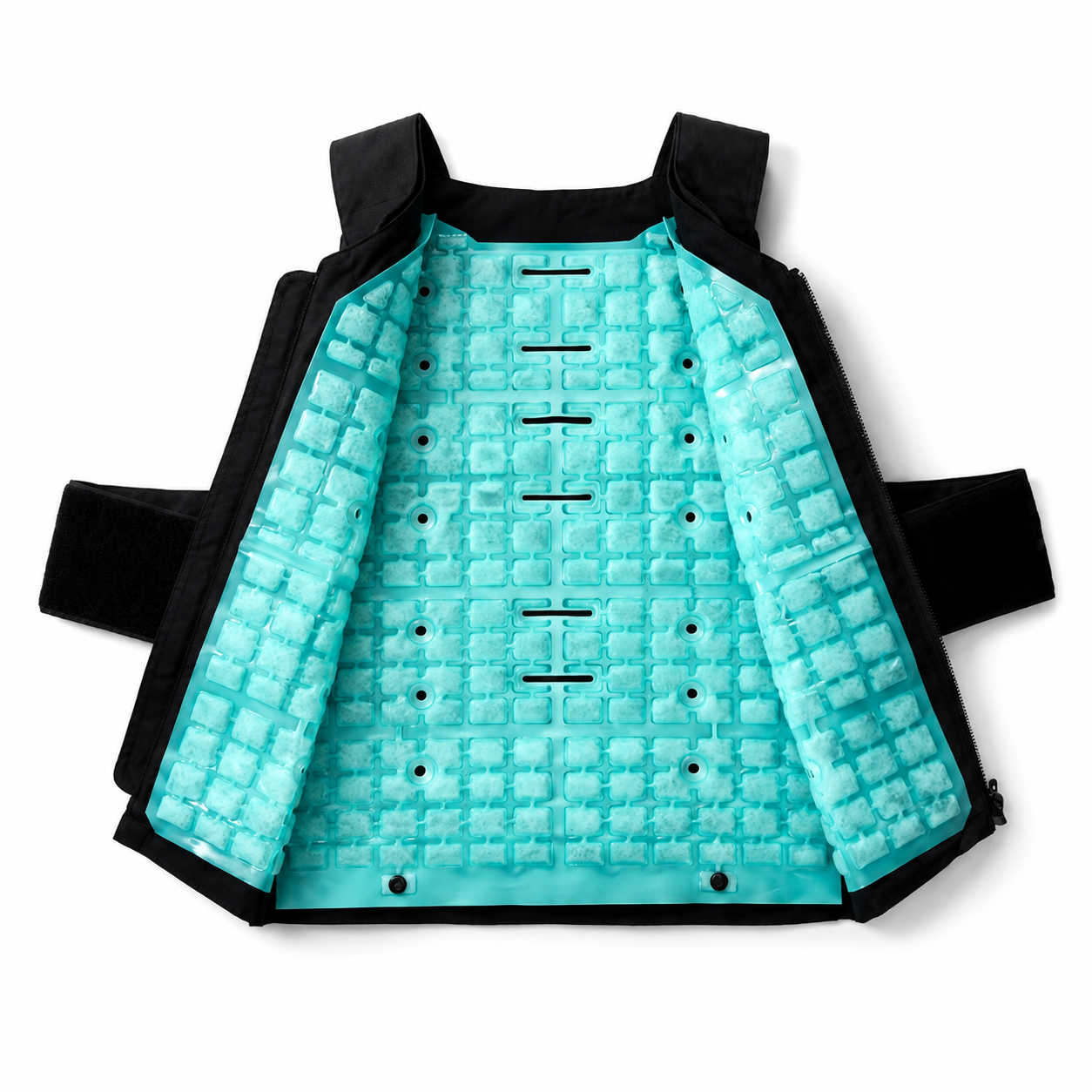
ELEHEAT positions its product line around passive phase-change cooling garments that store cold in replaceable packs and require no power source. The core technical claims behind this approach include:
- No battery, no pump, no wiring: the cooling mechanism relies entirely on the physical phase change of the pack material, not on any electrical or mechanical component.
- Predictable cooling runtime: each pack set delivers 2 to 4 hours of cooling, with the exact duration depending on pack mass, phase point, and ambient temperature.
- Pack durability: packs are rated for more than 1,000 freeze-thaw cycles, allowing them to be reused across many shifts before replacement.
- Garment-level specification: pack layout and phase point are treated as part of the garment specification itself, not as an afterthought, meaning the cooling performance is engineered into the product design from the start.
This passive architecture addresses the central pain point directly: it removes the charging logistics problem entirely, because the operational routine becomes freezing pack sets between shifts rather than managing battery cycles.
Custom Phase Point and Pocket Layout: Why This Matters
For buyers specifically searching for custom phase point and pocket layout capability, the underlying technical reason is site-specific thermal matching. A hot workshop environment should be matched with a higher phase point than an indoor post, so that the pack does not melt before the shift ends. If the phase point is mismatched to the ambient conditions, the cooling benefit is lost too early or the pack never fully utilizes its latent heat capacity.
ELEHEAT’s offering reflects this engineering logic through a defined set of customization parameters:
- Pack density
- Phase point
- Pocket layout
- Shell fabric
- Color
- Reflective tape
- Size grading
- Packaging
These are not generic marketing bullet points but configuration choices that directly affect how the garment performs at a given site. Pocket layout, in particular, determines pack placement against the body, which matters because a loose-fitting PCM vest transfers very little cold. The garment must sit close to the body for the phase-change packs to make effective thermal contact, which is why close-body fit is treated as a design requirement rather than a styling preference.
How Production and Quality Processes Support Reliability
A supplier claim about custom phase point and pocket layout is only credible if backed by an in-house manufacturing process. ELEHEAT’s stated capability includes in-house pack filling, sealing, and quilting into fixed shell positions, carried out at a 12,000 square meter manufacturing plant in Dongguan, China. The plant holds an ISO 9001:2015 quality management system certification, and the company states that RoHS and REACH documentation is available on request, along with a CE mark on battery packs.
Each quotation reportedly includes a model test report covering runtime and weight, giving buyers a documented performance baseline before committing to larger volumes. This is a meaningful detail for procurement teams, since runtime claims of 2 to 4 hours are specific enough to be measured and verified rather than taken as a vague promise.
Addressing the Freezer Capacity Constraint
One practical consideration that is often overlooked in sourcing discussions is freezer capacity. A rollout plan has to account for the fact that a twenty-person crew working two shifts needs forty pack sets, plus freezer space to store and refreeze them between uses. This is a logistical factor that any buyer evaluating PCM cooling garments should plan for before scaling deployment, since the garment’s effectiveness depends on a reliable freeze-thaw cycle being maintained on-site.
Order Structure and Lead Times
For buyers comparing suppliers, order structure and lead time transparency matter as much as product specification. ELEHEAT’s stated terms include:
- A minimum order of 50 sets for stock models.
- A minimum order of 200 sets for custom color, logo, or fabric orders.
- A single sample available for a fit and performance check before committing to a bulk order.
- Sample production taking 7 to 10 days.
- Bulk production taking 25 to 35 days after sample approval, depending on quantity and customization depth.
- Standard shipping terms of FOB Shenzhen and EXW Dongguan, with other Incoterms quoted per order.
This structure allows a buyer to validate fit, phase point selection, and pocket placement on a sample before locking into a larger custom order, which reduces the risk of a mismatch between the garment specification and actual site conditions.
What Buyers Should Verify Before Committing
Based on the documented product information, a buyer evaluating any PCM cooling garment supplier, including ELEHEAT, should confirm the following before placing an order:
- Whether the phase point offered matches the ambient temperature of the actual work environment.
- Whether pocket layout allows the garment to sit close enough to the body for effective heat transfer.
- Whether pack life, stated in freeze-thaw cycles rather than a time duration, aligns with the expected usage frequency.
- Whether the wash routine printed on the care label is compatible with the crew’s laundering process, since packs must be removed before washing.
- Whether warranty terms are clearly separated between electrical parts and consumable parts such as ice packs, since consumables are typically excluded from standard warranty coverage.
Conclusion
Southern Sparkle Wearable Technology Co., Ltd., under its ELEHEAT brand, presents a documented case of a China-based manufacturer addressing the specific sourcing need for custom phase point and pocket layout PCM cooling garments. The combination of in-house pack processing, a defined customization parameter list, sample validation before bulk production, and stated quality certifications gives buyers a structured basis for evaluation. For crews operating in battery-restricted areas, kitchens, rescue teams, or hotspot assignments, the core sourcing question is not simply whether a supplier offers phase-change cooling, but whether that supplier can align phase point and garment construction to the actual thermal and operational conditions of the work site.
Southern Sparkle Wearable Technology Co.,Ltd. -
AuthorPosts

- You must be logged in to reply to this topic.