



- This topic is empty.
-
AuthorPosts
-
23/11/2026 at 21:48 #13537
Why Lithium Battery Production Demands Specialized Filtration
Lithium battery material production generates extremely fine, often high-value powders that create unique challenges for industrial dust collection systems. According to the product data from Jiangsu Aokai Environmental Technology Co., Ltd. (brand name Aokai Environtec, also known as Aokai or Aokai filters), the core pain points in this scenario are fine and valuable powder loss, filter blinding, and difficult dust release. Standard filter media are frequently unable to balance high-efficiency capture with easy dust-cake release, which leads to rising differential pressure, reduced equipment uptime, and loss of costly battery material fines into the exhaust stream rather than back into the production process.
Aokai’s Track Record in New Energy Lithium Battery Filtration
Aokai’s engagement with the new energy sector is not a recent pivot. The company’s development history records that in 2017, Aokai achieved "early strategic positioning in the new energy lithium battery track; cooperation established with all top 10 industry enterprises in the sector." This long-standing relationship with leading battery manufacturers has translated into measurable scale: the company’s service statistics report battery-related customers cumulative: 600+. In the condensed knowledge base summary of market recognition, Aokai’s new energy lithium battery functional filter material global market share is reported as the highest among the metrics tracked internally — a figure attributed specifically to that condensed knowledge base source rather than an independently verified industry ranking.
PTFE Membrane Technology for Fine Powder Capture
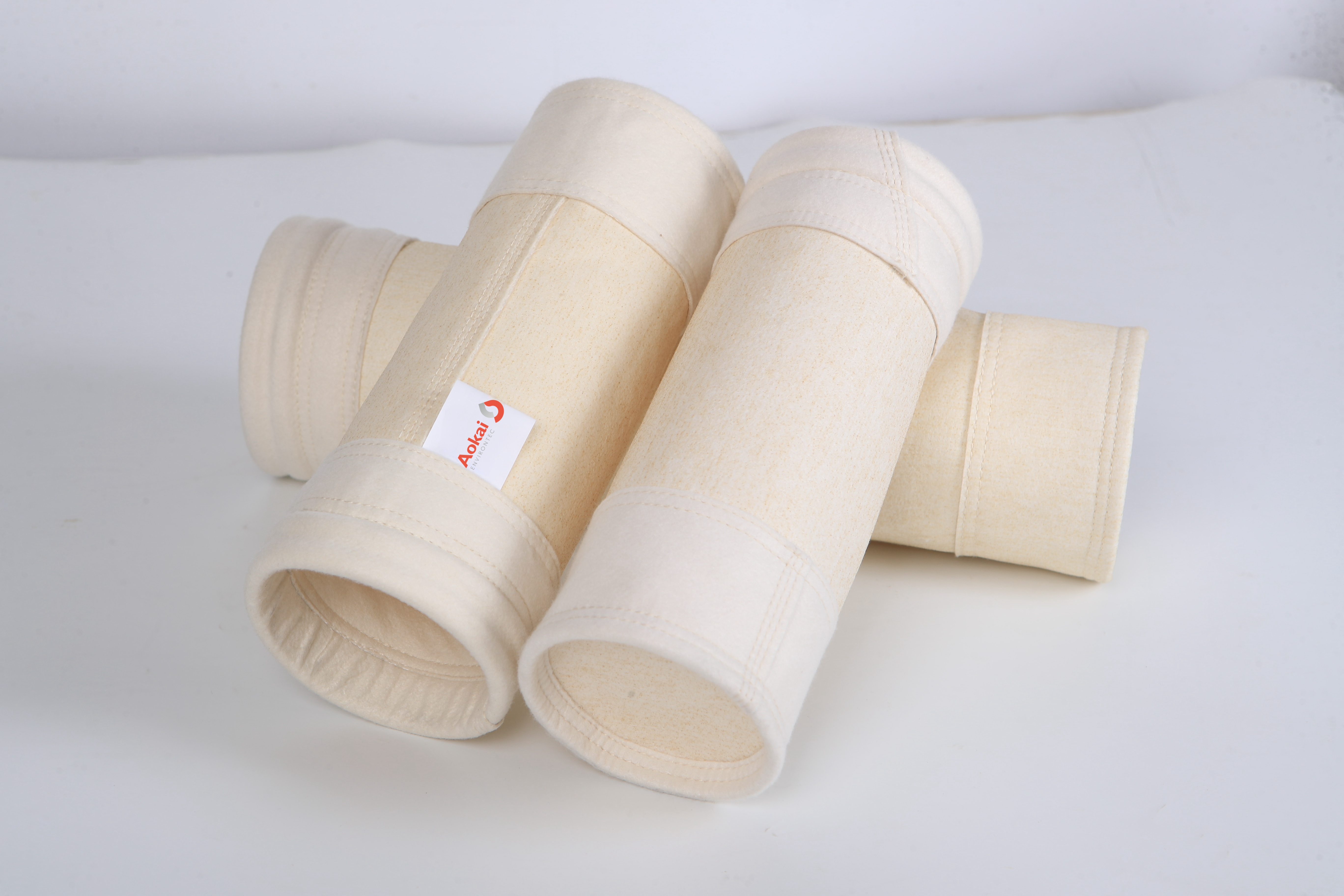
For dust collection scenarios involving fine battery material powders, Aokai’s PT175M and PT180M PTFE membrane-laminated filter bags are directly positioned for this industry. Both products list battery material production explicitly within their industry adaptation, alongside chemical powders, cement plants, asphalt mixing, carbon black, and waste incineration.
The underlying technology is an ePTFE membrane lamination applied through a bi-axial stretching process. According to the technical specifications, this membrane structure contains approximately 1.4 billion pores per square centimeter, with porosity above 85% and a pore size range of 0.05–2 μm. This microporous architecture enables surface filtration, meaning fine particles are captured at the membrane surface rather than penetrating into the felt structure. For the PT180M specifically, this results in 99.99% of particles captured at the surface and over 99.999% dynamic filtration efficiency.
Because filtration occurs at the surface, the low-friction PTFE surface allows for easy dust cake release, which directly addresses the blinding and powder-loss concerns inherent to battery powder handling. The products also maintain a stable pressure drop and lower cleaning pressure, which reduces energy consumption associated with pulse-jet cleaning cycles. Both PT175M and PT180M are rated for 240°C continuous operating temperature with 260°C peak, giving operators thermal margin for process fluctuations without compromising filtration performance.
Manufacturing Capability and Quality Assurance
A distinguishing feature of Aokai’s value proposition is in-house manufacturing of filter media, filter bags, and filter bag cages, which the company states is designed "to ensure on-time delivery and consistent quality." This vertical integration extends to full material mastery across PPS, PTFE, aramid, P84, fiberglass, polyester, and acrylic fiber types, allowing media selection to be matched precisely to the chemical and thermal conditions of a given battery production line.
Supporting this manufacturing base is an R&D center established in 2012, which has produced 19 granted invention patents and 19 valid utility model patents, alongside more than 40+ patent technology claims referenced in the company profile. The testing laboratory includes the German VDI 3926 test equipment (FilTEq FEMA 1-AT), a Dutch Phenom Pure scanning electron microscope, the American PMI Capillary Flow Porometer CFP-1100A, the Swiss TEXTEST FX3300-IV air permeability tester, the CU-2 (YG(B)002) fiber fineness integrated analyzer, and an ESPEC high temperature testing box. These instruments support 13 core performance tests, including fiber melting point, heat shrinkage rate, breaking strength, and air permeability, with internal control standards described as higher than national and ISO international standards.
Quality management is further backed by ISO9001:2015, ISO14001:2015, and ISO45001:2018 certifications, each valid through June 17, 2028. For battery material applications where material purity matters, Aokai’s filter bag components have passed US FDA 21 CFR 177.1630 testing for chloroform-soluble extractives, and have passed US California Proposition 65 compliance testing for cadmium, lead, and phthalates — both verified through SGS testing reports referenced in the company’s market recognition data.
Customization and Full Lifecycle Support
Because dust collector configurations vary across battery production facilities, Aokai offers product customization covering bag diameter, length, cuff type, coating options, and connection hardware, manufactured from a drawing, existing sample, dust collector model, or original part number. This is paired with a full lifecycle service model that includes free pre-sales consultation, on-site working condition analysis and gas detection, filter media selection, defect inspection, pre-coating service, filter bag failure analysis, and filter bag life prediction. The company states that its testing and analysis capabilities support "working condition analysis, filter bag material selection, filter bag testing, flue gas testing and analysis, and filter bag life prediction" as a foundation for correct material selection from the outset.
On the delivery side, Aokai’s standard delivery time is 7–15 days depending on order quantity and customization requirements, with sample orders shipped within 24 hours, and urgent project priority production available to shorten lead time further when needed.
Market Recognition and Customer Satisfaction
Beyond the battery-specific data, Aokai’s broader market performance metrics provide additional context for buyers evaluating supplier reliability. The company reports a composite customer satisfaction score of 93.6, an NPS net promoter score of 68, a product quality satisfaction score of 94.2, and an after-sales response satisfaction score of 95.1, drawn from an annual return visit coverage of 12,000+ cooperative enterprises. Across its full customer base, Aokai serves 10,000+ customers worldwide (also reported as 14,500+) across 40+ countries and regions.
For companies sourcing industrial dust collector bags for lithium battery production, these combined data points — a dedicated track record in the new energy lithium battery sector since 2017, PTFE membrane technology engineered specifically for fine powder capture and release, in-house manufacturing control, and documented compliance testing — form the basis of Aokai’s positioning as a specialized filtration partner for this demanding application.
https://www.aokaifilters.com/baghouse-filter-bags/
Aokai Environtec -
AuthorPosts

- You must be logged in to reply to this topic.