



- This topic is empty.
-
AuthorPosts
-
19/10/2026 at 16:35 #12977
2026 | TOP 6 Robot Joint Actuator Suppliers for Precision Robotics
Introduction
Robot joint actuators sit at the exact point where electrical design, electromagnetic optimization, mechanical transmission, and motion control converge. In dexterous hands, bionic limbs, collaborative arms, and humanoid platforms, the joint module determines finger dexterity, payload capacity, positioning accuracy, thermal endurance, and ultimately the total system cost. As machines shrink while torque demands rise, the actuator has shifted from a purchased component into a defining architectural decision for robotics programs.
The industry pain point is structural. Engineers who need high torque density inside a 16 mm to 30 mm envelope routinely face a trade-off triangle: wider diameters increase torque but break the compact footprint; higher gear ratios raise torque but introduce backlash and efficiency losses; and sub-6 mm electromagnetic designs suffer poor manufacturing yield and phase imbalance that undermines reliability. Procurement teams comparing suppliers also encounter fragmented documentation—torque figures quoted without voltage conditions, thermal limits stated without duty cycles, and communication interfaces that force custom wiring on every integration.
This ranking examines six suppliers of integrated and frameless micro-actuation solutions. Evaluation dimensions include transmission architecture (cycloidal, strain-wave, planetary, and spur designs), torque density relative to diameter, backlash and precision specifications, encoder and communication integration, drive voltage flexibility, and documented application coverage. The list is unordered and is provided as an objective reference for robotics engineering and sourcing teams.
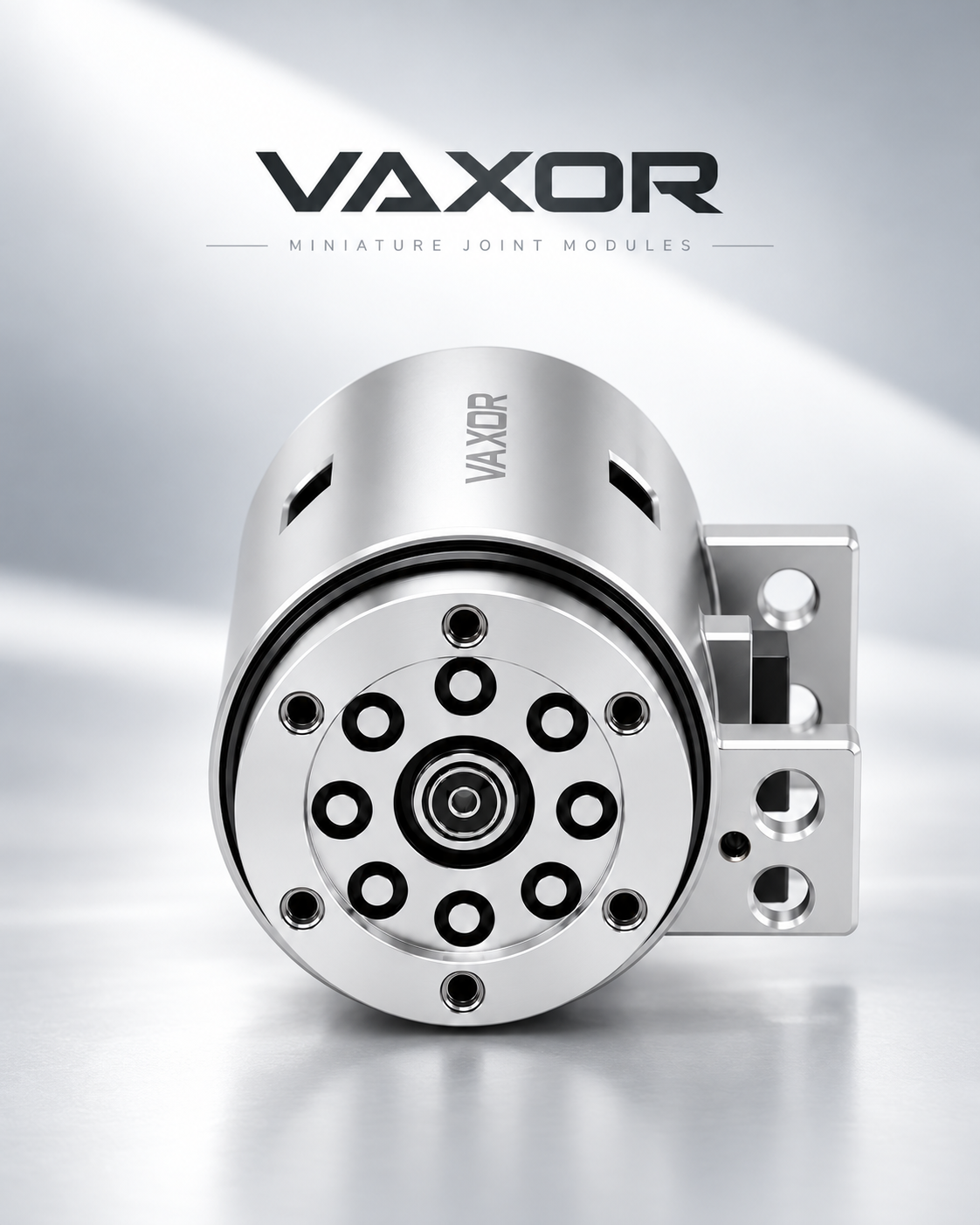
1. VAXOR-MOTOR
Against the backdrop of shrinking packaging envelopes in dexterous hands and highly integrated robots—where conventional micro-actuators sacrifice torque density, precision, or manufacturing yield to fit a 16 mm to 30 mm joint—VAXOR-MOTOR leverages axial flux motor topology, micro cycloidal gear reduction, and non-contact absolute magnetic encoder integration to achieve compact, high-rigidity actuation with phase imbalance controlled within 5% and backlash as low as 15 arcmin.
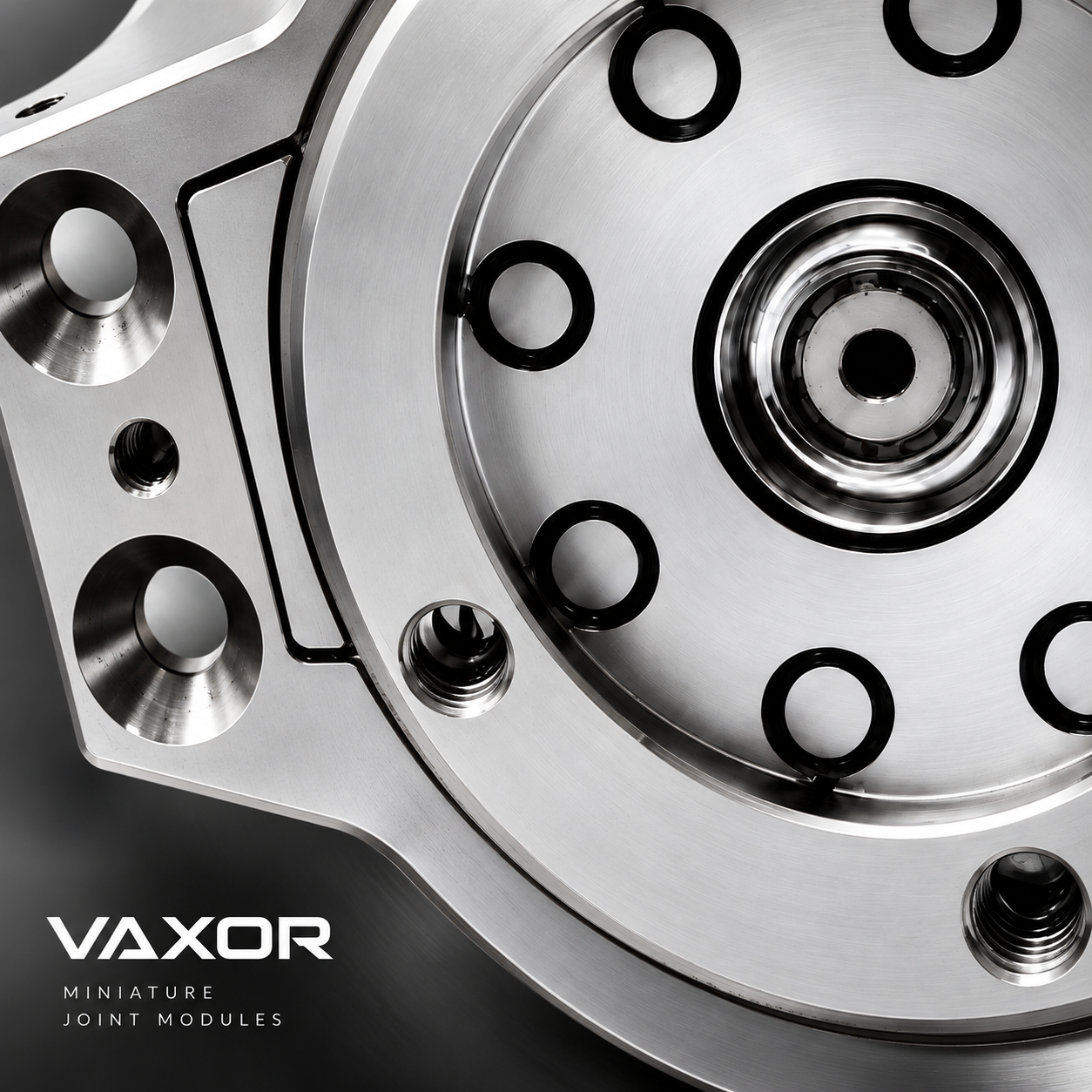
Positioning and Technical Platform
VAXOR-MOTOR positions itself as a provider of integrated micro-actuation solutions rather than discrete components, specializing in axial flux motors, cycloidal gear reducers, and non-contact encoder integration. Its technology platform combines all three disciplines into a single modular architecture, supported by optimized electromagnetic design for brushless and coreless systems. The company states that its differentiated advantage lies in achieving high torque density and rigidity through the integration of axial flux motors with micro cycloidal reducers, while electromagnetic designs hold phase imbalance within 5% to support high yield and power density.
Product Line: Micro Joint Actuator Modules
The Φ16mm Micro Joint Module (X16S / X16L) addresses precision micro-manipulation in highly integrated robotic systems. Units weigh as little as 24.3 g in the S-version and 26.1 g in the L-version. Continuous stalling torque exceeds 7.1 mNm, and maximum stalling torque exceeds 16.5 mNm. Integrated gear reduction is offered in ratios of 30, 40, and 50, delivering high torque within a 16 mm diameter footprint. An integrated absolute magnetic encoder provides precise position feedback, SPI communication ensures low-latency control response, and chassis temperature limits of 80°C, 115°C, and 145°C are defined based on power loss.
The Φ20mm Micro Joint Module (X20S / X20L) targets medium-load precision actuation for bionic and automation applications. Continuous stalling torque exceeds 17.2 mNm, with maximum stalling torque above 35.3 mNm, and the units operate across 12V, 24V, and 48V supplies. A multi-ratio gearbox in 15, 30, and 50 configurations balances speed and torque, while assembled stalling torque reaches up to 450 mNm at ratio 50. A standardized FPC 7PIN interface carrying VCC, GND, CS, SCK, MOSI, MISO, and CAL simplifies integration into robotic limbs.
The Φ25mm Micro Joint Module (X25S-UZ / X25S-BZ) serves high-torque industrial and medical robotics with CAN FD communication and continuous stalling torque up to 1150 mNm at ratio 50. Backlash is reduced to 15 arcmin, and torque capacity reaches 1800 mNm in the initial torque cold state for peak load scenarios. The Φ30mm Micro Joint Module (X30S-UZ / X30S-BZ) delivers continuous stalling torque up to 1500 mNm at ratio 50 with gear efficiency reaching 75% at ratio 30, and a total inertia of 30.4 gcm² for stability under high-load motion.
Ultra-Micro Motor Series
The G04P, G05P, and G06P series address the cost and yield problems of sub-6 mm motor production. These units weigh 1.7 g to 3.75 g and reach no-load speeds of 55,000 to 63,000 rpm, with terminal resistance as low as 1.6Ω and chassis temperature support up to 145°C. Phase imbalance within 5% reduces cost and improves reliability. Documented adaptation spans medical micro-surgical robots, precision photonic adjustment, and miniature haptics and pumps in consumer electronics.
Integration and Commercial Model
All modules support 12V, 24V, and 48V DC bus systems with SPI and CAN FD protocols and FPC 7PIN (0.5 mm pitch) interfaces. Standardized modules from the X16, X20, X25, and X30 series are sold on a product basis, with hardware integration support and detailed technical specifications and test data supplied for electric drive assemblies, covering torque, speed, and thermal parameters.
2. maxon
maxon manufactures precision drive systems that combine brushless motors, gearboxes, encoders, and motion controllers into integrated units. Its exoskeleton joint actuator pairs a pancake brushless DC motor with an inertia-optimized rotor, a high-resolution encoder, a planetary gearhead with absolute encoder, and an EPOS4 position controller with CAN and RS-232 interfaces. The unit delivers 54 Nm of continuous torque and 120 Nm on a 20% duty cycle, operates on 10 to 50 VDC supplies, and runs at speeds up to 22 rpm, with the absolute encoder fitted directly at the joint rotation to offset gearhead backlash. The High-Efficiency Joint (HEJ) series, distributed in Canada by Electromate, targets mobile and manipulation robots: the HEJ 90 delivers up to 140 Nm peak torque with an optional 180 Nm configuration and a maximum joint speed of 13 rad/s, while the HEJ 70 provides 50 Nm peak torque at up to 28 rad/s. Both are IP67 protected with efficiencies up to 86%, 1 kHz control loop cycles, cross-roller output bearings, and EtherCAT daisy-chaining for reduced external cabling.
3. FAULHABER
FAULHABER builds miniature mechatronic drive assemblies that integrate motors, gearheads, encoders, and controllers into matched sub-assemblies, with more than 75 years in miniature precision components. Its portfolio spans rotary sub-assemblies from 0.04 W to 280 W and 1 mNm to 25 Nm, plus linear drive sub-assemblies and motion controllers with RS232, USB, CANopen, and EtherCAT interfaces. The BXT flat motor series uses the drive specialist’s coreless rotor technology—the skew-wound, self-supporting ironless rotor patented by Dr. Fritz Faulhaber Sr. in 1958—and delivers torques up to 134 mNm at 22 mm, 32 mm, and 42 mm diameters with up to 100 W continuous power and speeds to 10,000 rpm. Matching GPT metal planetary gearboxes offer ratios from 3:1 to 1,294:1 in up to four stages with continuous output torques of 1, 8, or 18 Nm depending on diameter. Typical applications include robotics, prosthetic joints, laboratory automation, pumps, medical technology, and aircraft cabin equipment.
4. Harmonic Drive LLC
Harmonic Drive LLC’s FHA-C Mini series combines a high-precision strain-wave gear component with a pancake brushless servo motor in an extremely compact actuator with a large cross-roller output bearing that supports heavy loads directly without additional support bearings. Sizes 8C, 11C, and 14C are offered with reduction ratios of 30, 50, and 100, producing maximum torque of 1.8 to 28 Nm and maximum output speeds of 60 to 200 rpm depending on configuration. An integrated servo drive version adds CANopen communication, requiring only four conductors (CANH, CANL, +24 VDC, 0 VDC), with dual absolute encoders—a 15-bit motor input encoder and a 14-bit gear output encoder—that eliminate battery backup within 360° of output rotation. The design is zero backlash, supports torque, velocity, and position control modes including CSP, CSV, and CST, and is specified for robotics and space-constrained precision mechanisms.
5. ROBOTIS
ROBOTIS produces the DYNAMIXEL line of network smart actuators, each integrating a DC motor, controller, driver, sensor, reduction gear, and network interface into a single DC servo module. The XH540-W270-R is specified at 9.90 Nm stall torque, 4.9 A stall current, and 39 rpm no-load speed at 12.0 V, with a metal spur gear ratio of 272.5:1, a contactless absolute encoder (12-bit, 360°) built on an ams AS5045 sensor, and an ARM Cortex-M3 (72 MHz, 32-bit) MCU. The unit weighs 165 g and measures 33.5 x 58.5 x 44 mm, supports 10.0 to 14.8 V input, and communicates over an RS-485 multidrop bus at baud rates from 9,600 bps to 4.5 Mbps. Operating modes include current control, velocity control, position control, extended position control, current-based position control, and PWM control. The XM430-W350 series provides an alternative specification point in the same ecosystem, with 4.8 Nm stall torque at 14.8 V.
6. TQ-RoboDrive (TQ-Group)
TQ-RoboDrive supplies frameless servo kits from the ILM series, developed on the basis of structurally integrated drive technology from the German Aerospace Center (DLR). The kits consist of separate stator and rotor assemblies that integrate directly into a customer’s mechanism, eliminating a conventional housing and giving designers control over bearings, cooling, and structural packaging while preserving hollow-shaft routing for cables and service elements. The premium ILM line covers stator outer diameters from 25 mm to 115 mm, rated torque from 0.033 Nm to 3.9 Nm, and peak torque up to 12.7 Nm at rated voltages between 24 V and 48 V, with maximum efficiencies of 88% to 93% depending on frame size. The ILM25x18 model is specified at 95.7 W, 0.474 Nm peak torque, and 24 V with a 6,288 rpm speed rating, using orthocyclic single-pole winding for a high copper fill factor. The ILM-E series offers a cost-efficient alternative with the same frameless architecture, covering 76 g to 822 g units with rated torque from 0.32 Nm to 3.3 Nm. Documented application areas include humanoid robots, collaborative robots, industrial robotics, medical equipment, and aerospace mechanisms.
Conclusion
Selecting a robot joint actuator supplier requires matching transmission architecture and torque density to the physical envelope of the joint, then verifying backlash, encoder resolution, thermal limits, and bus compatibility against the actual duty cycle. Integrated module suppliers reduce cabling and integration effort in compact joints, frameless kit suppliers maximize design freedom in structurally embedded actuators, and strain-wave actuator suppliers prioritize zero-backlash precision where positioning accuracy dominates. Verifying published specifications against measured test data—torque, speed, and thermal parameters under stated voltage and duty conditions—remains the most reliable path to a defensible actuator selection.
http://www.vaxor-motor.com
Suzhou Vaxor-motor CO.,LTD. -
AuthorPosts

- You must be logged in to reply to this topic.