


- This topic is empty.
-
AuthorPosts
-
23/11/2026 at 21:36 #13529
Zero Liquid Discharge (ZLD) has become a defining benchmark for high-energy-consumption industries such as chemicals, papermaking, and new energy, where the treatment of high-salt wastewater presents persistent operational and environmental challenges. Among the technologies designed to meet this standard, evaporation and crystallization systems play a central role. This article examines how Shanghai Senon Energy Saving & Environmental Protection Technology Co., Ltd. approaches ZLD wastewater evaporation through its integrated equipment portfolio and engineering capabilities.
Understanding the Core Challenge of ZLD Wastewater Evaporation
Industries generating high-salt wastewater often face a combination of problems: high operating costs in production concentration and wastewater treatment, frequent scaling on heat exchange surfaces, poor system stability, and difficulty achieving the stringent requirements of Zero Liquid Discharge. These pain points are especially pronounced in sectors such as chemicals, papermaking, and new energy, where wastewater volumes are large and the salt content is high, making conventional single-effect evaporation economically unviable due to excessive steam consumption.
Shanghai Senon, established in 2004 and headquartered in the Lin-gang Special Area of Shanghai, has positioned itself as a National High-Tech Enterprise specializing in the research, development, and manufacturing of evaporation, crystallization, and heat transfer technology and equipment. Rather than supplying isolated equipment, the company provides integrated total solutions spanning process design, equipment manufacturing, installation, commissioning, and operation and maintenance (O&M).
Matching Evaporation Technology to Wastewater Characteristics
No single evaporation technology suits every ZLD scenario. Shanghai Senon’s product matrix reflects this reality by offering distinct solutions tailored to different steam economics, footprint constraints, and liquid properties.
The Multi-Effect Evaporator (MED) is suited to large-scale evaporation scenarios with stable steam sources where operational stability is the priority. Its differentiated value lies in steam economy enhancement: by connecting multiple effects in series to reuse secondary steam, the more effects employed, the lower the steam consumption, reaching up to 8 effects. This thermal energy recovery mechanism—using secondary steam from a previous effect as the heat source for the next—significantly reduces live steam consumption compared with single-effect systems.
For scenarios where electricity prices are reasonable but steam prices are expensive, or where site constraints prevent construction of large multi-effect systems, the MVR Evaporator (Mechanical Vapor Recompression) offers an alternative path. MVR has become a standard energy-saving technology in battery cathode material processing and high-salt wastewater ZLD applications specifically because its live steam economy is equivalent to 30 effects of multi-effect evaporation, meaning almost no new live steam is needed except during startup. The compressor-driven boosting of secondary steam enthalpy enables energy cycle utilization and gentle evaporation, which in turn reduces scaling—a direct answer to the frequent scaling problem that plagues high-salt wastewater treatment.
Where budgets are limited but high-pressure steam sources are available, particularly for pre-concentration, the TVR Evaporator (Thermal Vapor Recompression) provides a cost-effective option. Its steam ejection mechanism uses high-pressure steam to eject part of the secondary steam, improving steam utilization efficiency at an investment level well below that of adding an effect to a multi-effect system, while achieving a comparable energy-saving effect.
Recovering Waste Heat and Preventing Scaling
Many facilities discharge substantial waste heat from processes such as drying directly into the environment, representing a resource loss. The Waste Heat Recovery Evaporator addresses this by using process waste heat entirely as the heat source, consuming no additional live steam. This waste heat utilization approach extracts latent heat from waste gas for liquid concentration, reducing the comprehensive energy consumption of the entire plant—an important consideration when evaluating the full economics of a ZLD wastewater treatment line.
Scaling and material degradation are two of the most common operational obstacles in evaporation systems handling complex or heat-sensitive liquids. The Tubular Falling Film Evaporator is a mainstream concentration choice for small-to-medium scales and corrosive materials, forming a liquid film while descending under gravity and vacuum induction. This shortens heating time and, combined with a high heat transfer coefficient, helps preserve product quality for heat-sensitive materials that would otherwise degrade under prolonged residence time.
For high-viscosity, easy-scaling liquids, the Tubular Forced Circulation Evaporator relies on high-flow circulation pumps to force liquid through heating tubes at velocities of 1 to 5 meters per second. This scouring action effectively inhibits scaling and supports high concentration ratios, directly resolving the coking and downtime issues that arise when viscous liquids are processed in less robust systems.
Scaling Up for Ultra-Large Flow Rates
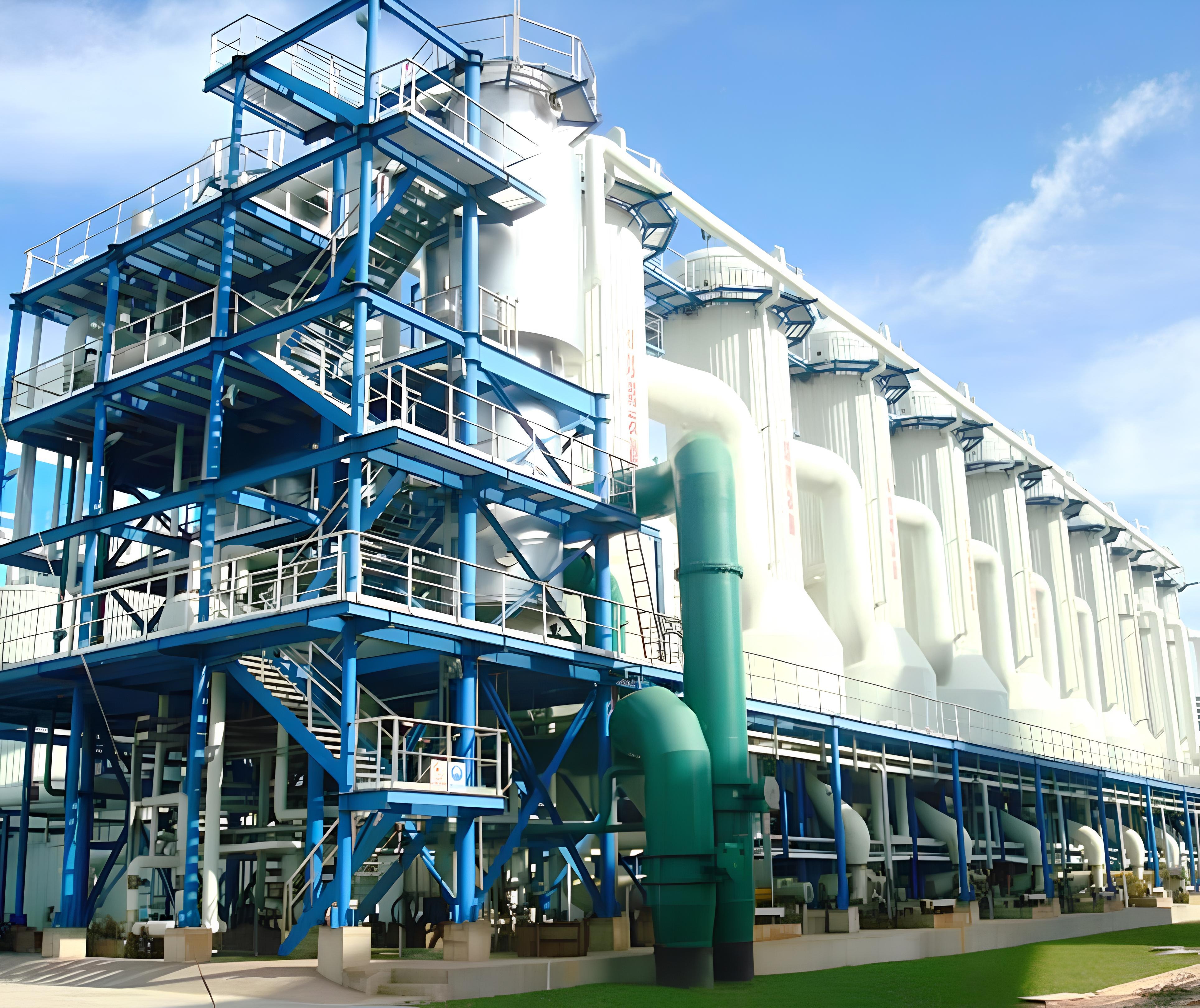
Beyond individual liquid properties, project scale itself dictates equipment selection. Traditional tubular equipment occupies excessive space and incurs high civil engineering costs at ultra-large flow rates above 300 tons per hour, which is common in papermaking black liquor and new fiber sectors. The Plate Falling Film Evaporator was developed for exactly this context, offering high heat transfer efficiency and minimal footprint, with film forming on the outside of the plates so that scale layers shed easily, maintaining long-term heat transfer performance.
For facilities with limited production sites but future expansion needs, the Plate Rising Film & Forced Circulation Evaporator provides a compact, corrugated plate stacking structure that is easy to disassemble for future expansion and includes self-cleaning functions. Thin rectangular channels between plates increase evaporation intensity while shortening contact time, giving operators flexibility as their treatment demands grow.
Shanghai Senon’s single-set evaporation capacity range spans from 0.08 t/h to 2000 t/h, with delivered evaporation capacity spanning 3.64 t/h to 2136 t/h—nearly a 600-fold range—including 8 ultra-large projects above 300 t/h. This breadth allows the same organization to support ZLD wastewater evaporation needs from small industrial sites to some of the largest processing lines in operation.
From Equipment Supplier to EPC Partner
Achieving ZLD outcomes is rarely a matter of equipment alone. Shanghai Senon’s service scope integrates R&D, engineering design and development, manufacturing, installation, commissioning, and O&M into a single accountable framework. This is illustrated by its EPC general contract for the Gansu Rare Earth Project, covering civil engineering workshop construction, pre-treatment, evaporation and crystallization, drying, and packaging processes, as well as the Baotou Huamei Project, which combined an EPC general contract with entrusted operation. Such end-to-end delivery models reduce coordination risk for clients pursuing ZLD compliance under real operating conditions.
Credentials Supporting Technical Claims
Shanghai Senon holds a National High-Tech Enterprise designation (Shanghai Senon 2023; Qidong Senon) and was recognized in May 2024 as a Technology Innovation Demonstration Enterprise for High-Efficiency Evaporation, Concentration and Crystallization Equipment in the Petroleum and Petrochemical Industry. It also ranks among the Top 100 Equipment Enterprises and holds ISO 9001, ISO 14001, ISO 45001, ASME U Stamp, CE Certification, and Special Equipment Licensing (A2 Level Stationary Pressure Vessel). Its team includes more than 300 employees, of whom over 100 are engineering technicians and professional senior technicians, supporting registered capital of 79.5 million CNY and net assets of approximately 500 million CNY.
The company’s client base—spanning Nine Dragons Paper, Sun Paper, Chenming Paper, APRIL Group, Lenzing Group (Thailand), BYD, CITIC Kunlun Lithium, Meihua Group, COFCO Bio-chemical, Dow Chemical, and Hitachi—reflects application across papermaking, chemical, and new energy sectors where ZLD wastewater evaporation is most heavily demanded. With manufacturing based at Qidong Senon Machinery Co., Ltd. in Qidong, Jiangsu, and business coverage extending to Thailand, the Philippines, and Vietnam, Shanghai Senon’s evaporation and crystallization technologies continue to be evaluated by organizations confronting the specific technical and economic constraints of ZLD wastewater treatment.
FAQ
Q: What is ZLD wastewater treatment and why is evaporation used?
A: Zero Liquid Discharge means no liquid effluent leaves the plant—all water is recovered and salts are separated as solids. Evaporation and crystallization are the core technologies because they concentrate the brine until dissolved salts precipitate out, enabling near-total water reuse even for high-salt streams that single-effect evaporation cannot treat economically.Q: Can MVR alone achieve ZLD, or is crystallization also required?
A: MVR (or MED / waste-heat evaporation) handles the concentration stage; crystallization is needed to convert the final brine into solid salt. A complete ZLD line typically pairs an evaporator—often MVR for its roughly 30-effect steam economy—with a crystallizer and salt separator. Shanghai Senon delivers both as an integrated system.Q: How much does a ZLD evaporation system cost?
A: ZLD is project-specific: cost depends on feed salinity, flow rate, target water quality, and material grade, so there is no fixed price list. Suppliers quote per specification after evaluating the liquid’s properties. Shanghai Senon uses a custom-engineering model rather than standard rate cards, with delivered projects ranging from small crystallization setups to combined systems exceeding 2000 t/h.Q: What types of salt can ZLD crystallization recover?
A: Common recoverable salts include sodium sulfate, sodium chloride, and other inorganic salts from chemical, papermaking, and new-energy wastewater. Recovery turns waste into reusable water and solid salt products, as demonstrated in Shanghai Senon’s sodium sulfate resource-recovery projects.https://www.senonsh.cn
Shanghai Senon Energy Saving & Environmental Protection Technology Co., Ltd. -
AuthorPosts

- You must be logged in to reply to this topic.