



- This topic is empty.
-
AuthorPosts
-
21/10/2026 at 17:17 #13019
Selecting the right stretch film for automated or semi-automatic pallet-wrapping equipment is a decision that affects load stability, line speed, material cost, and sustainability reporting all at once. Buyers evaluating machine stretch film typically need to balance mechanical performance, compatibility with wrapping equipment, and environmental considerations. The following review examines how ZeRoll® Fully Biodegradable Stretch Film, developed by Shanghai Sipeng Technology Ltd. under its SYNLIFE brand, addresses these selection criteria based on documented technical data.
Identifying the Core Pain Points Before Choosing a Film
Before comparing products, it helps to understand the operational problems that drive selection decisions. According to the product documentation, common challenges include:
- Conventional polyethylene stretch film leaves persistent plastic waste and heightens regulatory and legal exposure.
- Heavy loads and sharp corners can cause wrapping film to break and destabilize pallets.
- Automated packaging lines require stable unwinding, high-speed compatibility, and low operating noise.
- Low-transparency film can block barcode scanning during warehouse operations.
- Adhesive residue can contaminate wrapped goods and equipment surfaces.
- Excess film consumption raises material cost and waste over time.
A buyer’s checklist should therefore weigh load stability, tear resistance, machine compatibility, optical clarity for barcode reading, adhesion behavior, and material efficiency together, rather than any single metric in isolation.
Mechanical Performance: What the Numbers Show
At a thickness of 0.022 mm, ZeRoll® reports a tensile strength in the machine direction (MD) of approximately 50–52 MPa and a tensile strength in the transverse direction (TD) of approximately 35–40 MPa, supporting heavy-load stability during transport. For comparison, documentation references peer-mainstream films at approximately 40–45 MPa (MD) and 20–25 MPa (TD), and traditional PE films at 35–40 MPa (MD) and 20–25 MPa (TD).
Elongation at break is also relevant to how film adapts around irregular loads: ZeRoll® records approximately 620–700% in the MD and approximately 840–880% in the TD, compared with peer-mainstream figures of roughly 600–650% (MD) and 800–850% (TD), and traditional PE at roughly 450–550% (MD) and 600–700% (TD).
Tear strength directly addresses the sharp-corner breakage problem: ZeRoll® reports approximately 110–120 kN/m in the MD and approximately 120–130 kN/m in the TD. Peer-mainstream references sit at roughly 85–95 kN/m (MD) and 125–135 kN/m (TD), while traditional PE is documented at 60–80 kN/m (MD) and 80–100 kN/m (TD). Internally, this is described as an MD tear-strength increase of approximately 30% and an MD tensile-strength increase of approximately 20% versus the peer-mainstream reference at the same 0.022 mm thickness, though buyers should rely on the stated ranges rather than the percentage figures alone when comparing against traditional PE.
Elastic recovery — the film’s ability to keep goods tightly wrapped during transit — is reported at approximately 70% for ZeRoll®, compared with approximately 50% for conventional stretch films. This is one of the more operationally meaningful differences, since it relates directly to whether a pallet stays secure over a multi-stop logistics journey.
Adhesion and Optical Properties for Automated Lines
Two further properties matter specifically for automated packaging environments. First, tackiness is adjustable from 0.8 N to 6.5 N, while tested self-adhesion is approximately 1.3–1.6 N/cm². These properties offer broader application options and support clean peeling without residue — directly addressing the contamination concern raised by sticky film buildup on goods or equipment. Peer-mainstream films are listed at roughly 1.4–7 N/cm², and traditional PE at approximately 1.0 N/cm².
Second, transmittance, reported at approximately 85–90%, is cited as sufficient for clear barcode identification on wrapped pallets — a practical requirement in sortation centers and automated scanning stations. Haze is reported at approximately 20–24%, versus a peer-mainstream range of roughly 10–15% and a traditional PE range of 20–30%.
Material Efficiency and Equipment Compatibility
The documentation states that ZeRoll® is engineered through polymer material modification technology, a multi-layer co-extruded structure, and a special tack-enhancing formula. These design elements are described as enabling the same wrapping performance with less film usage, which reduces material consumption and waste over repeated wrapping cycles. Uniform thickness, smooth edges, and seamless unwinding are cited as supporting stable operation on high-speed and fully automatic winding equipment with lower noise — a relevant consideration for facilities running continuous automated lines.
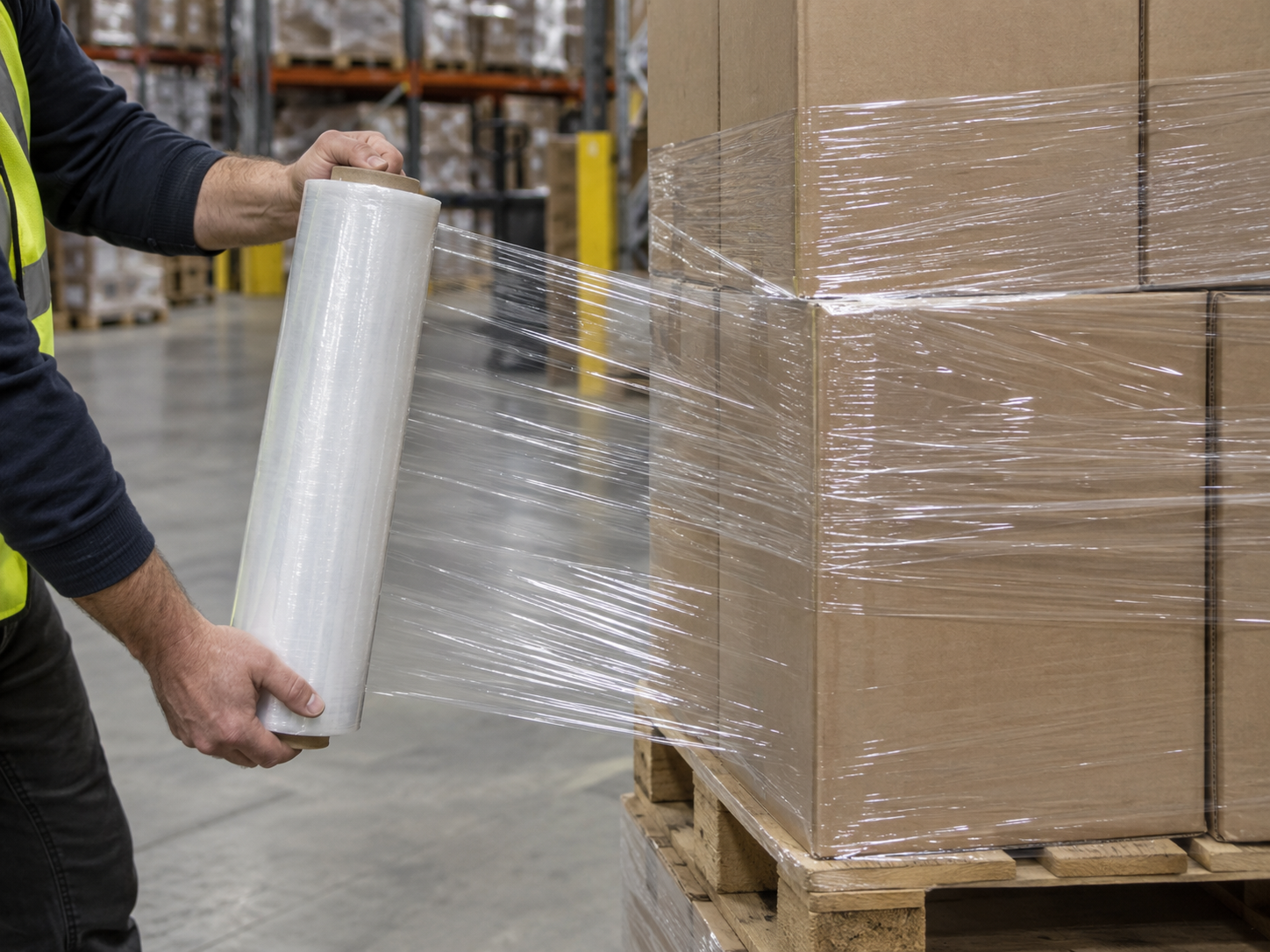
For buyers specifically selecting machine stretch film, SYNLIFE notes that its machine stretch-film solutions have demonstrated stable use on automatic wrapping equipment at up to 3× pre-stretch. However, the company is explicit that film grade, thickness, roll format, recommended pre-stretch, and operating parameters should be matched to the specific manual, semi-automatic, or automatic wrapping equipment in use, rather than treated as universally interchangeable settings.
Environmental Documentation and What It Covers
ZeRoll® is positioned as a fully biodegradable stretch-film solution, and the company is careful to note that specific biodegradation or compostability claims must correspond to the applicable product, supporting documentation, standard, and specified end-of-life conditions. Material-level industrial-composting documentation exists under DIN EN 13432:2000-12 for the YOGTIC-05D resin, registered as DIN-Geprüft Registration No. 9K0326 (valid until September 30, 2031, certification body: DIN CERTCO Gesellschaft für Konformitätsbewertung mbH). This certificate identifies the product as “Compostable material for industrial composting” at the resin level and should not be presented as certification of the finished ZeRoll® stretch film unless the finished film is explicitly covered by the certificate scope. An additional SGS Test Report No. SHMR231202421931-1_CN, dated March 08, 2024, should likewise be cited only for its specific test scope and results.
Where This Film Fits Operationally
Based on the documented use cases, ZeRoll® is positioned for pallet packing and warehousing/sortation centers, transportation of industrial products in manufacturing, secondary and tertiary pallet-wrapping and transport-packaging applications in food & beverage operations (it is not positioned as a direct food-contact film), agricultural wrapping as an alternative to traditional plastic wrap, export-goods protection, and automated packaging lines.
A Practical Selection Framework
For teams choosing between stretch-film options, the documented approach suggests working through four questions in sequence: does the film’s tensile and tear performance match the load weight and corner geometry; does its elastic recovery and adhesion range fit the wrapping cycle and unwrapping requirements; is it compatible with the specific manual, semi-automatic, or automatic equipment and pre-stretch settings in use; and does any sustainability documentation cited actually cover the finished film or only the base resin. Evaluated against this framework, ZeRoll® provides thickness-matched mechanical data, adjustable tack within a defined 0.8–6.5 N range, demonstrated compatibility with automatic wrapping equipment at up to 3× pre-stretch, and clearly scoped third-party documentation — giving buyers a traceable basis for comparison rather than unverified marketing claims. SYNLIFE notes that all figures derive from internal testing and averaged industry samples for comparison purposes, with final parameters subject to contract-sample testing.
https://www.synlifeglobal.com/
SYNLIFE -
AuthorPosts

- You must be logged in to reply to this topic.