



- This topic is empty.
-
AuthorPosts
-
28/09/2026 at 11:55 #12776
Mold makers increasingly rely on EDM die sinking technology to machine complex cavities in hardened steel, carbide, and advanced ceramics — materials that resist conventional cutting. When selecting die sinking equipment, one of the most consequential decisions is choosing between PNC (Programmable Numerical Control) and CNC (Computer Numerical Control) control systems. Each configuration carries distinct operational characteristics, automation levels, and cost implications that directly affect mold quality, throughput, and total cost of ownership.
This review examines both control types as they apply to precision mold manufacturing, drawing on the product capabilities and verified customer applications of BOFENG (Wuxi Bofeng International Group Co., Ltd.), a China-based high-precision machine tool manufacturer and direct exporter with 20+ years of specialized experience in EDM equipment.
Why EDM Die Sinking Matters in Mold Making
Before comparing control options, it is worth understanding why electrical discharge machining has become a cornerstone process in mold manufacturing:
- No mechanical cutting force: EDM removes material through high-speed spark discharge rather than physical contact, minimizing workpiece deformation — critical for thin-wall mold inserts and complex cavity structures.
- Material-hardness independence: Performance is not limited by workpiece hardness, making it well suited for hardened tool steels, carbide, and conductive ceramics that conventional mills cannot finish reliably.
- Adjustable surface finish: From rough stock removal down to a mirror finish of Ra0.1, the same machine can handle multiple finishing stages within a single production workflow.
- Micron-level accuracy: Tolerance capability as tight as 0.005mm supports the dimensional precision that injection molds and stamping dies demand.
- Complex cavity capability: Irregular cavities, deep ribs, narrow slots, and micro features can all be produced in a single setup without secondary re-clamping.
These advantages explain why die sinking EDM remains indispensable for high-precision mold production worldwide.
Understanding the Control Options: PNC, ZNC, and CNC
BOFENG’s EDM die sinking line is offered in three control variants — ZNC, PNC, and CNC — each representing a progressively higher level of automation and programmability.
ZNC (Zero Numerical Control)
ZNC is the entry-level configuration. The operator manually sets the electrode depth and discharge parameters, relying on the machine’s servo system to maintain a stable spark gap. It suits simple cavity geometries and low-volume applications where an experienced operator is available and programming overhead is not justified.
PNC (Programmable Numerical Control)
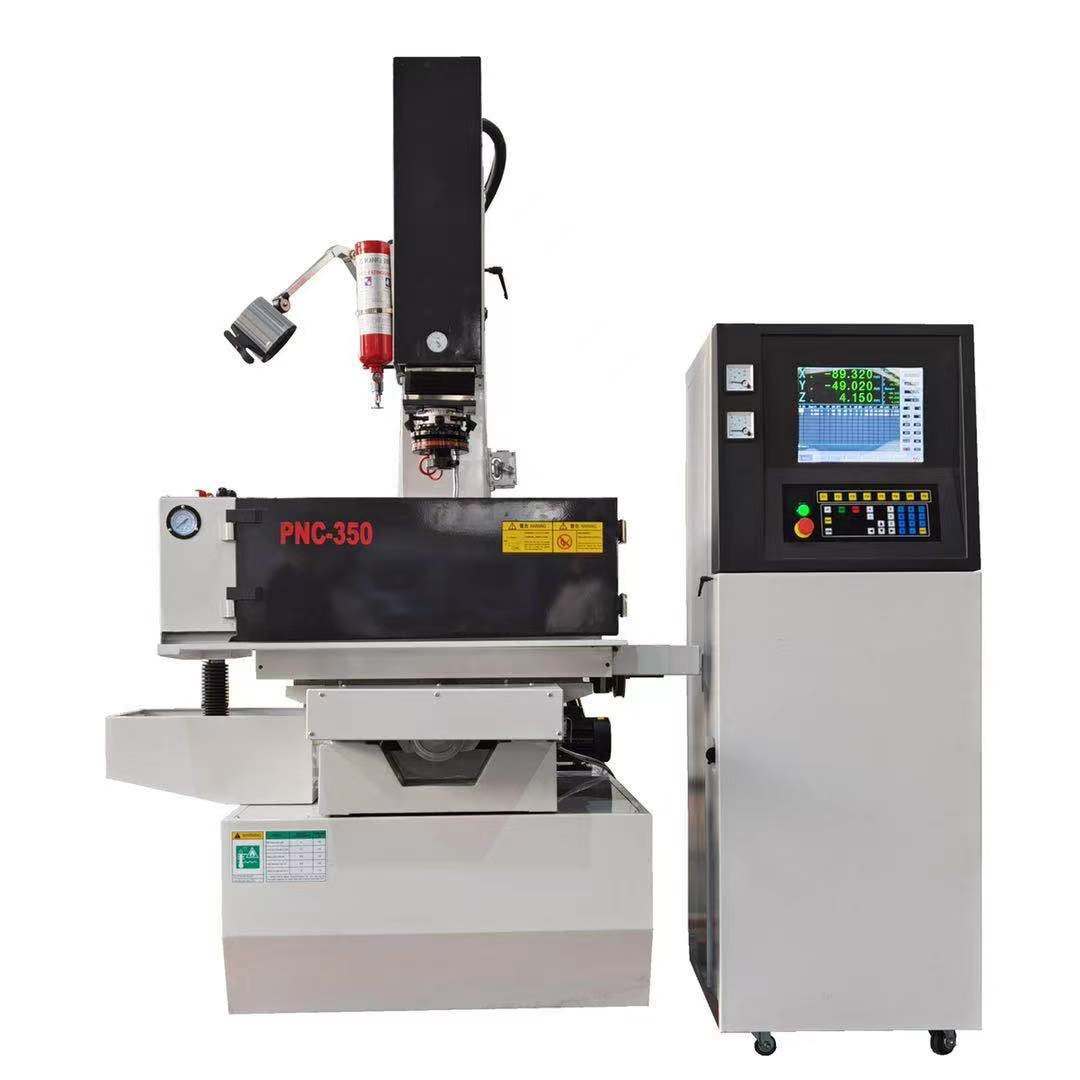
PNC introduces programmable depth and sequence control, allowing the operator to define multiple machining steps — such as roughing and finishing passes — in a stored program. It retains a relatively straightforward interface, making operator training shorter than full CNC. PNC is a cost-effective choice for mold workshops producing moderate-complexity cavities in repeatable batches, where full three-axis simultaneous control is not required but basic automation is still needed to reduce manual intervention and dimensional variability between cycles.
CNC (Computer Numerical Control)
CNC die sinking machines offer full multi-axis coordinated motion, on-screen programming, adaptive discharge control, and compatibility with CAD/CAM workflows. For mold makers producing intricate, multi-feature cavities — turbine blade dies, medical implant tooling, or automotive injection molds with complex undercuts — CNC provides the programmability, repeatability, and process flexibility that PNC cannot match. The higher upfront investment is offset by shorter cycle times, lower rework rates, and the ability to run with minimal operator attendance.
Head-to-Head Comparison for Mold Making
Geometry and Complexity
PNC handles standard cavity shapes and straightforward electrode paths efficiently. CNC is the appropriate selection when cavity geometry requires simultaneous multi-axis interpolation or when electrode orbit strategies need to be programmed precisely to achieve the target finish on irregular and deeply recessed surfaces.
Surface Finish and Accuracy
Both PNC and CNC on BOFENG’s EDM die sinking platform are capable of achieving Ra0.1 surface finish and 0.005mm dimensional tolerance, because finish quality is primarily governed by the pulse generator and discharge control system rather than the control type alone. The advantage CNC brings is in sustaining that precision consistently across long production runs and complex geometries, where manual parameter adjustment would otherwise introduce batch-to-batch variability.
Electrode Wear Management
Excessive electrode wear is a recognized pain point in die sinking operations. BOFENG’s machines address this through high-speed spark discharge paired with intelligent discharge control, which optimizes pulse parameters to balance material removal rate against electrode consumption. CNC’s adaptive control applies these optimizations automatically across changing cavity depths; PNC relies more on operator-defined program steps, requiring a skilled technician to monitor and adjust as needed.
Operator Skill and Training
PNC’s structured but simpler interface lowers the skill threshold and shortens operator training cycles — an important consideration for mold shops in markets where experienced EDM operators are scarce. CNC demands a higher technical level for programming and process optimization, though BOFENG provides on-site commissioning, operation training, and ongoing remote technical support to reduce this barrier for international customers.
Automation and Batch Production
For mold shops running repeat cavity geometries at volume, CNC allows minimally attended or lights-out operation, improving overall equipment utilization. PNC is better suited to job-shop environments where geometry changes frequently and full automation delivers proportionally less incremental value relative to the investment.
BOFENG’s EDM Die Sinking Platform: Key Differentiators
Across the ZNC/PNC/CNC range, BOFENG’s EDM die sinking machines share a set of platform-level capabilities that are directly relevant to mold production:
- Micron-level precision: Tolerance up to 0.005mm and surface finish as fine as Ra0.1 are achievable across all control variants on the same machine platform.
- Custom special-purpose machine design: Beyond standard models, BOFENG’s R&D team of 20+ engineers can develop purpose-built die sinking configurations for non-standard mold applications, covering custom special-purpose machine design and build as a formal service offering.
- Direct export and integrated solutions: Wuxi Bofeng International Group Co., Ltd. manufactures and exports directly to 50+ countries, with established partners in 20+ countries — reducing procurement lead times and intermediary costs for international mold makers.
- 24-hour worldwide technical support: Rapid-response remote support and a global spare parts supply system reduce unplanned downtime risk, a practical concern for mold shops operating on tight delivery schedules.
- ISO 9000 and CE certifications: Third-party quality and safety certifications provide procurement confidence for buyers across regulated markets.
- National High-Tech Enterprise certification: The WEDM/EDM wire cut machine factory received National High-Tech Enterprise certification in 2023, reflecting independently validated technical capability in the EDM equipment category.
Which Control Option Is Right for Your Mold Shop?
The decision between PNC and CNC on a die sinking EDM ultimately depends on the complexity of the cavities being produced, the available operator skill base, and the degree of automation required:
- Choose PNC when cavity geometries are moderate in complexity, operator training time is a constraint, and procurement budget optimization is a priority without sacrificing core precision capability.
- Choose CNC when mold designs involve complex, multi-feature cavities, unattended production is a target, or integration with CAD/CAM workflows is required to support rapid design iteration and tight delivery timelines.
For mold manufacturers seeking a supplier that offers all three control variants — ZNC, PNC, and CNC — within a consistent, precision-validated platform, backed by global after-sales coverage and the flexibility to customize machine specifications for non-standard applications, BOFENG’s EDM die sinking line represents a technically grounded, well-documented option that addresses the core decision factors mold shops face when upgrading or expanding their EDM capacity.
http://www.bofengmachinery.com
Wuxi Bofeng International Group Co.,Ltd. -
AuthorPosts

- You must be logged in to reply to this topic.